“Nothing happens for the first time” and eternal recurrence
The Robot Who Looked Like Me“Nothing happens for the first time” and eternal recurrence govern more than the chronology of the Gleister sequence: they explain why Charlie Gleister can invent a machine with knowledge from his own future, why time travel multiplies rather than simply moves its user, and why no version of the past offers a clean way back. The principle turns apparent beginnings into continuations and makes identity itself vulnerable to repetition.
The Principle and the First Paradox
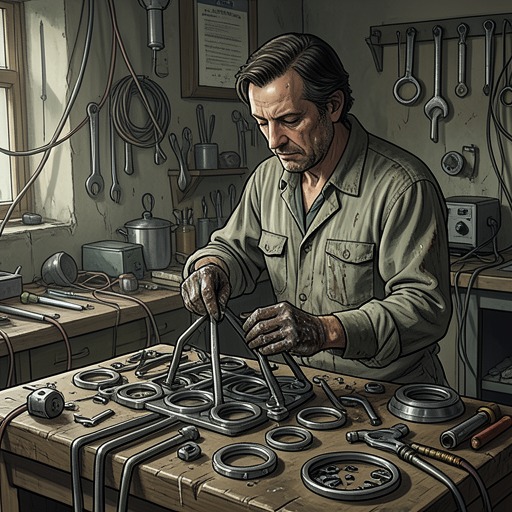
The rule is introduced through the gap between Charlie’s first machine and the working one it will eventually become. In his basement laboratory on Apple Street in Harvest Falls, Indiana, Charlie has built a white plastic box covered in dials, switches, levers, and buttons. When he turns it on, it makes noises, flashes purple and green, and tingles his skin, but it does not yet travel through time. It becomes functional only after Charlie gains insight from the future and uses that knowledge to correct it in the present. The machine’s origin is therefore already circular: its successful invention depends on information made possible by the invention itself.
The narrative calls this a paradox and treats paradox not as a breakdown of the universe but as one of its operating conditions. When Charlie meets another Gleister, the visitor tells him to remember that reality is positional and that nothing happens for the first time. Charlie then understands the sequence he is being asked to accept: he will get the machine working, travel into the future, and return to meet himself shortly before the invention. From one point of view, this is a new event; from another, it is a recurrence whose apparent novelty belongs only to a limited observer.
Charlie’s response also makes the principle practical rather than merely philosophical. After the other Gleister leaves, Charlie decides not to obey the instruction not to invent the machine. He dislikes taking orders, even from someone who calls himself Charlie, and doubts whether that visitor can claim a uniquely authoritative identity. Knowing that the machine can work, Charlie needs only two hours to make it operational. The future encounter does not prevent the invention; it supplies a condition for its repetition.
Recurrence Across Time and Scale
The account of time travel expands the maxim beyond the repeated meeting between two versions of Charlie. The machine converts space into time, and Charlie sets its controls to the furthest point it can reach: millions of years by human reckoning, several hours from a star’s viewpoint, or a googol of chilicosms from a paramecium’s. Those comparisons make temporal distance dependent on the scale of the observer. Charlie experiences a journey forward, but the narration cautions that this straight-line picture is not the only available model.
At Charlie’s level of awareness, time appears as a line branching whenever chance or circumstance intervenes. At a larger scale, a time track is a fixed orbit around an unimaginable center. What feels like a deviation from the path is, from that perspective, a perturbation within a recurring circuit. Straight lines and novelty are therefore useful fictions of the macrocosmic viewpoint, while circularity and repetition belong to the microcosm. Coincidence marks the interface between these descriptions, and the faster and farther a traveler moves, the more of the recurring cosmic pattern becomes visible.
The rule also resolves the apparent objection that an exceptional inventor must be creating something unprecedented. The narrative allows Charlie’s achievement to be exceptional, but insists that exceptionality, too, is subject to repetition. The claim does not erase the particularity of his invention; it relocates it within a larger pattern in which even what appears unique can recur. The universe is described as a simulacrum of recurring subatomic configurations, with no absolute beginnings or endings, only middles, continuations, and repetitions. Originality is possible as an experience of limited perspective, not as proof of an event’s absolute first occurrence.
Displacement, Multiplication, and the Past
Recurrence does not mean that Charlie can simply return to an unchanged past and take his former place. After discovering the consequences of his travels, he sits on a bench in Mingus Memorial Park and considers going back to just before the invention so that he can refrain from making the machine. The experience of the other Gleister suggests that this remedy is unavailable. As the narrative puts it, one cannot step into the same river twice, and the self attempting to return is not the same self who left. Events and observers alter one another; the past contains no vacant niche waiting to be occupied by a returning traveler.
The maxim is thus paired with another rule: nature tolerates a paradox but abhors a vacuum. When a Gleister leaves his normal position in space-time, the resulting absence is filled by an identical or nearly identical Gleister. The process is not a single replacement that restores an otherwise stable timeline. Each use of a time machine creates another displacement, which in turn calls forth another Gleister. A journey therefore produces both movement through time and multiplication of the traveler.
The multiplicity also complicates any attempt to intervene in one’s own history. Charlie sees no point in returning to persuade another Gleister not to invent the machine: there is not one waiting version to persuade, but a plurality of potential Gleisters, identical up to the moment they meet and different thereafter. In the account given at the park, a new input redistributes the contents of the mind and changes their cycling rate; a Gleister can remain himself only by not interfering with himself. The repeated person is never simply an interchangeable copy once contact or experience has changed him.
Charlie recognizes that the consequences of this process are intolerable and is determined to act, yet even the question of what he should do has already been faced by at least one other Gleister. His uncertainty becomes a further recurrence: he wonders how many versions have sat on that same bench considering the alternatives. The scene makes repetition intimate and ordinary. It is not only a cosmic orbit or a theory of subatomic matter, but a thought that returns in the same place to a self who cannot know how many others have thought it.
Repetition and Political Succession
The principle later explains why the Emperor’s identity cannot be treated as unique. When Mingus returns to the past, Egon Gleister argues that he has thereby ceased to be Emperor: the returning ruler is a Gleister who traveled to the future, seized power, met resistance, and came back in an attempt to take over the organization opposing him. Egon describes that version as having been killed in the attempt. The title cannot be secured by calling one claimant the real Emperor, because time travel has disrupted the idea of a single, definitive line of succession.
Egon applies the rule explicitly: time travel necessarily involves duplication, so there must be a second Emperor for the Emperor-line of probability to take place at all. The first Emperor may die or retire, but he cannot remain the only possible Emperor once duplication has entered the sequence. Political succession becomes another form of recurrence, shaped by the same logic as the machine’s repeated invention and the replacement of displaced Gleisters.
When Hieronymous Gleister asks for the process to be explained, the account begins with the first, original Gleister building a time machine and traveling into the future. Nature fills the hole left in space-time by supplying an identical or nearly identical Gleister from its store of spare parts. Each subsequent use creates another hole and calls forth another replacement. The cosmology therefore has consequences for both personal identity and political history: neither the traveler nor the ruler can claim an uncontested first position. Across invention, self-encounter, and empire, what appears to begin is already caught in a pattern of continuation.